Residency Period:
1 November 2014 - 31 October 2015
Bio
Kelly Malec-Kosak is an artist in Columbus OH, and is the Chair of Fine Arts at Columbus College of Art & Design. She received her MFA from California College of the Arts in Oakland CA. Her work has been featured nationally and internationally, most recently in "Protective Ornament: Contemporary Armour to Amulet" at the National Metal Museum and "Reflection: 100 Years of Jewellery/Metal Arts at CCA" in Oakland CA. She has received an Individual Excellence Award from the Ohio Arts Council, and the International Residency in Dresden Germany from the Greater Columbus Arts Council. In 2012, she traveled to Ravenstein, Netherlands to study with Ruudt Peters and a group of international artists. Malec-Kosak's work has been featured in Metalsmith, Humor in Craft by Bridgette Martin, and On Body and Soul: Contemporary Armour to Amulet by Suzanne Ramljak.
URL: www.kelly-malec-kosak.com
On-hiatus Proposal Summary
As higher education continues to evolve and adapt, Kelly finds herself in a unique and frustrating position in her own artistic practice. As the chair of Fine Arts at Columbus College of Art and Design, she has been tasked, along with the faculty, of restructuring the Fine Arts curriculum to better relate and adjust to the changing climate of higher education and art. The tremendous amount of research and collaboration demanded by this, along with her other work and personal obligations, has pre-empted her ability to participate in her art practice in any meaningful way.
During her residency at RFAOH, Kelly has decided to solely focus on this task of restructuring a college art program with a fundamental objective of writing an outstanding and relevant Fine Arts and Crafts curriculum, while also travelling for research purposes to various academic and commercial art sectors. She believes that her on-hiatus endeavour will lead to a new direction in her work and impact her art-making once she returns to it.
Final Report
I would first like to thank Shinobu and Matt for their incredible support - as I mentioned in my post, this residency period came at a time of personal and professional difficulty. I hadn't anticipated either, and Shinobu and Matt would gently guide me back on track with encouragement and reminders. That said, I am sorry I didn't participate as fully as I would have liked. But I appreciated the other artists in the residency, reading their posts and activities.
I started out with the intention of posting updates on reworking a curriculum, and that evolved into writing a new major for our college. I did wind up reaching my goal: the proposal and courses were submitted to our accreditors in August, and I'm still waiting to hear if it's approved. I'm weirdly OK either way - despite the hours spent, I was able to let it go quite soon afterwards. Now that I've had time to reflect, I can think of several things that probably aren't right and need to be reworked. I think, if nothing else, I should learn from this year I shouldn't sweat the little things.
The biggest thing I learned from this period of reflection: it made it clear that I desperately needed to get back to my work. As I looked back over the last three years, I became horrified that I allowed it to slip away - administrative duties, teaching, family all took priority over my work. While I know life ebbs and flows, it became intolerable to me, particularly in the last two months of the residency, that I haven't made anything of significance recently. No investigations, no research for myself, no experimenting. This really hit me the hardest when I started teaching a studio course this fall - I almost dropped out of the residency just to make something. I couldn't take it.
I'm back in the studio, but my idea of studio has changed. It's not a place - it's where/when/how I can make something. I can't set aside hours to work - not at this point in my life. So, I have to adapt. Right now, my studio is a canvas bag, which holds a capezio body suit, black thread, scissors and needles. I'm altering the suit through repetitive stitches, thinking with my hands. I discovered, to my delight, that TSA lets you take needles on airplanes (?) and recently, my studio and I went to San Francisco, where i enjoyed five hours of uninterrupted time, stitching, thinking, tying knots. I still am not sure why or what I'm doing. But I'm making, and I can't ask for more than that.
I think this residency helped me prioritize what I'm doing. I really had to think about why I've done what I've done - and how to change it. I thank you for the opportunity.
On this last day of Februray, I finally make my post – as the email reminder from Shinobu and Matthew says, “Februrary is the cruelest month.”
One of my larger, non-residency goals was met – I met with my deans and our provost, and I was approved to write a craft curriculum to go up for approval in the fall with NASAD. I had a long proposal written to justify the move, and under my dean’s directive, reduced it to bullet points (I had to google, “writing effective bullet points”) so the information was easy to digest in a 10 minute meeting. I was excited but sad at the same time – all that work and research was reduced to:
What is it:
Professional craft study with an imbedded minor in business
Digital integration with hands-on making
Conceptual emphasis for the high-end market
Why should we do it:
Name recognition for the college for unique programming, with potential enrollment growth
Facilities, faculty and much of the curriculum already exist
Columbus is perfect location to launch innovative programming
There’s a practical side to writing all this, and I believe in professionally preparing students, but I had a certain amount of reservations writing “embedded minor in business” and “high-end market.” I question the way we educate crafts majors in the united states – I find myself more in line with, say, the Dutch and how they approach materials and ideas. In the crafts areas where I teach, students are usually in two camps: they create production work they hope to eventually sell, or they use the material conceptually, usually in a more sculptural way. They don’t do well together in critiques, as they view each other as “sell outs” or “art freaks.” One of my goals in writing this major was trying to find a home for both groups, and my fear is that by trying to make everyone happy, no one will. It will be challenging as the months go on, and I work with my colleagues, to maintain integrity and create a unique identiy to this program.
On a more personal note, I really loved what Heather wrote in her last post about “cheating.” It’s been really funny and odd to do this residency – as I stated at the start, I really haven’t made any significant work in years due to the administrative nature of my job, having two young children at home, and just life. But once I declared that I WASN’T going to make anything, I find myself like a recovered smoker or someone who has decided not to eat gluten. I WANT to make things – but I worry that I violate the terms of the residency if I even grab a sketchbook or play with some materials. I felt sneaky when I made paper robot sculptures with my kids on a snow day a couple of weeks ago.
Enrique - sorry for the delay in response. I will definitely check that book out! I really appreciate the information. I often feel like there is a lot of paper to be pushed...
enrique wrote on Mar 14:
Hi Kelly ! I used to work in an arts faculty at my university, and had some similar problems (I suppose): i.e. the standards that work for most of the university knowledges areas does not work as well in the art academic ambient, but we had to follow many of those standards, so we always had a lot of desk work in order to find a solution, and now that I see it from the distance, I think that there is no easy solution, or maybe none. The historic point of view of some books from Arthur Efland helped me a lot to see (and guess) what will the future may hold for those who, like us, enjoy the work of teaching in a university. It helped me despite the differences of two unequal art histories like the North American and the Latin American cultures, but also connected (more and more every day). Right now, I'm more interested in the recognition of some "autonomous" art activities that emerge without formal education. I guess art activities will always be available out of the art institutions. Best wishes for you !!
shinobu wrote on Feb 28:
Ahh, it's so great to have you all here.. The variety of on-hiatus projects, the motivations behind, circumstances -- all pointing to the prickly questions over "art as a profession". Let's keep it coming (;
It´s Finally Hitting Home
As of just this week—today in fact—it’s really starting to sink in, what I’ve committed myself to here.
I have to confess something: even though I started this commitment on February 1st, and I have not intentionally set out to make any art, and in fact have sometimes gone out of my way to avoid making art, I’ve still been engaged in a few practices related to my art making practices. For example, I’m in the midst right now of trying to sort out the timing of a deinstall for a show that closed last week. (Technically it was not in violation of the RFAOH contract for me to be in this show because it opened in January, and the gallery had no official opening hours after the opening because of extreme weather. And it got zero press coverage even though it was actually a really good show—one of the best handful of gallery shows in Boston that I’ve seen this year so far. And not because my work was in it. My work was not that strong.) Anyway, even though deinstalling/planning deinstalling is not by any stretch of the imagination an art-making practice, if I’m honest with myself, it’s an art-charged experience. As long as I’m planning to deinstall or actually deinstalling a show, I’m still in a cycle of art making. If I’m deinstalling, it means I’m thinking about whether I’ll be able to find another place for an artwork, or whether I might recycle its components and how. It’s more than that. It’s like the way that striking a set is no less a part of show business than throwing one up or performing or auditioning. The ritual and the continuous reinforcement of the ritual is tied into all of the other rituals and their reinforcement, which together make up the practice of show business—or art making.
But let me continue confessing. In addition to planning to deinstall a show, and therefore still having the drug of maintaining an art practice coursing through my veins, I’ve also been in negotiation with curators around two potential future projects that I had proposed a while back via open calls for work. I had made it through to the second round of review for both, and was interviewing for one and discussing details for the other with each curator respectively through today. So again, though not actively making art, thinking about making art, planning to make art—doing what I always do when one project has ended and another one hasn’t begun yet: laying groundwork for the next thing. And in my heart of hearts, though this process does not quite exactly feel like art making per se, it comes very, very close to the edge. Like one pica away. If I’m discussing my ideas and refining them with a curator, that is about as close to the art making process as gathering supplies is. It’s made me feel a little guilty that I’m being deceptive within the context of RFAOH. That’s part of how I know it’s so close to the line. But that all came crashing to a standstill today. I was narrowed down to among the final 3 candidates for a prestigious local commission, but in the end it was determined that my proposed work would be too ephemeral for the setting. And in the other case, a potential appearance at a performance festival was nipped in the bud for essentially legal reasons—a permitting process was deemed too labor and cost intensive to pursue.
So now I really truly have nothing on the horizon. I feel like I’m standing in a desert, with wind and sand blowing around me and everything looks exactly, endlessly the same—flat and mid-toned—in every direction. It’s a terrifying feeling.
I keep feeling a pull towards my studio, and this ongoing filler project that I have been working on very slowly for years. Just a little habit I’ve made to fill up the moments when I’m between projects—I trace things—particular things, and so far the tracings just pile up. It’s a soothing, non-linguistic way of keeping my art juices flowing when no concrete idea is ready to be worked on, but I can’t go to it now because even though it never really quite feels like making art when I’m doing it, I do hope to assemble all of the pieces into something and present the sum total as art someday. So during RFAOH, it’s off limits.
And next week I was planning to go and pull some pages with some images on them out of some books that are being discarded, but I’m not sure I should even do that—my intention is to eventually use the images for art making, so the process of determining which ones to keep and which ones to let go of is essentially part of the art making process. As is the care that will be involved in removing the pages so that they can be used. It won’t look like art making, but I’ll know. On the other hand, the books will be gone in a week or so, so if I don’t do it now, I’ll lose the art material I want permanently.
There are other questions like these. Can I sand the paint of off something that I want to eventually repaint for an art project? Can I hawk the residue from a previous project at a fundraiser? I’m looking at things as both simple actions that can be separated from their meanings and via the lens of intention.
Which reminds me that I should talk in here about conversations I’ve been having with other artists about actions, meanings and intentions as art mediums. About experiences as art mediums. Not just about the content of the conversations, but about whether having them constitutes some kind of art activity as well.
But I’ll save that for another entry. To ring in March, I’ll try to talk about these conversations a little bit as well as answer some of the questions I posed at the beginning of February.
Meanwhile, here’s an image from one of the projects that isn’t going to happen.
May 1st was the birthday of her best childhood friend. She always remembered her and this is a lovely quote from 1986:
“Remember how as a child it took an eternity for Christmas to come and my birthday and the Eaton’s catalogue. Was only interested in one item in the later – pencil boxes. Saturdays were too long so Blanche and I waited for the Telegram containing the “Children’s Page”. That was over 50 years ago.”
Yes they are all of my Mother as she was growing up. Oddly I have none of my Father growing up and wish I did.
shinobu wrote on Feb 28:
are these photos all your mom?
7
Tengo 6 meses de ser voluntario en Misión del Nayar. Ahí participo en reuniones con jóvenes que vienen de comunidades indígenas situadas en zonas rurales situadas entre los estados de Jalisco, Nayarit, Zacatecas y Durango en México. En esa zona habitan Wirrarikas, Coras, Tepehuanes, Mexicaneros. Vienen a Monterrey a estudiar preparatoria y facultad apoyados por la Misión del Nayar que les entrega becas de escuela, hospedaje y alimentos. Es un grupo pequeño de jóvenes entusiastas que deben adaptarse a diferentes situaciones al llegar a una ciudad como Monterrey, como son las distancias urbanas, la lengua (de cora a español, a inglés), la discriminación, la diferencia en los niveles académicos, etc. Mi contribución es apoyarlos en algunas de sus tareas de la escuela cuando lo solicitan (desde mi campo: arte, historia, sociología, filosofía, herramientas de redacción). También he encontrado interesante acompañarlos en sus encuentros de futbol rápido. Acercarme a esta realidad me ha permitido enterarme de otras cosas, como que en México se hablan 68 lenguas. Para este año estoy a cargo de un proyecto de Cine Foro en el que podremos ver películas poco conocidas, y además, discutiremos acerca de la importancia del cine en la formación de los individuos contemporáneos. El primer ciclo está listo, hice un poster para dar a conocer la programación. Empezaremos el próximo viernes. Están todos invitados, habrá palomitas !
• • • • •
I have been a volunteer at Misión del Nayar for six months now. I participate there in meetings with young students who come from native communities in rural areas between the states of Jalisco, Nayarit, Zacatecas and Durango in Mexico. In this areas live Wirrarikas, Coras, Tepehuanes, Mexicaneros. They travel to Monterrey to study high school and faculty, supported by the Mission Nayar, who offer them school scholarships, accommodation and meals. It’s a small group of enthusiastic young people who must adapt to different situations as they come to a city like Monterrey, i.e. urban distances, language (Cora to Spanish, and English), discrimination, different academic levels, etc. My contribution is to give them support in some of their homework, when requested (from my field: art, history, sociology, philosophy, writing tools). I also found interesting to cheer their soccer encounters. I guess that’s our national sport, indeed. For me, getting closer to this reality has allowed me to learn about other things, i.e. that 68 languages are spoken in México. This year I’m in charge of a Film Forum project, where we will watch not so commercial movies, and also discuss about the importance of film in the formation of contemporary individuals. The first cycle is ready. I made a poster for the program. We will start next Friday. You are all invited, popcorn for everyone!
"The role of knowledge and art, as the ancient Greeks understood, is to create ekstasis, which means standing outside oneself to give our individual life and struggle meaning and perspective. The role of art and scholarship is to transform us as individuals, not entertain us as a group. It is to nurture this capacity for understanding and empathy. Art and scholarship allow us to see the underlying structures and assumptions used to manipulate and control us. And this is why art, like intellectual endeavour, is feared by the corporate elite as subversive. This is why corporations have used their money to deform universities into vocational schools that spit out blinkered and illiterate systems managers. This is why the humanities are withering away.
Hi Milena! Mmh... Well, yes, i think that it is hard to offer them a different approach to the movies, but I try. Seems to me that the contemporary world lives in the hollywood forest, or in the satellite TV space. Like in the movie Leviathan, there is no way out the "system". It's a monster, write Hobbes, and if we dare to fight it, we are aware that it is also inside of the self. I do agree that art may help to change people, but what kind of art are we talking about? It doesn't occur every time, nor everywhere. It is not a panacea. I'm sure that it is helpful because it is a weapon for the artist. As an artist (although i'm on hiatus), I'm the first person that gets the benefits: I'm capable of transforming something inside of me. But what I argued before, in the Davos event, is that there are also art events not meant to transform people or situations. Music, visual arts, digital art, dance. First it is obligatory to analyze which event or what art action in particular is taking place, and second, open a discussion about what is called to change. It is never an "a priori". There are thousands of art forms. For instance, the movies: trivial entertainment or transcendental art? Saludos !!!
milena kosec wrote on Mar 5:
" importance of film in the formation of contemporary individuals" - about changing by art?
By the way, I agree with Matt about Leviathan film.
shinobu wrote on Feb 28:
Year totally, Zidane will cover it all -- art + foot ball!
enrique wrote on Feb 28:
thanks matt, hadn't heard of it until now, and just found it on youtube, i'm going to take a look !! by the way this week I enjoy "leviathan" (russia), pretty impressive, no doubt, in a wim wenders way. Saludos !!
Matt wrote on Feb 27:
Great programme Enrique.
I had this thought Douglas Gordon's Zidane movie would cover all your bases :)
The entries for these two years had me thinking about Ian constantly.
While the sterotype of men is to not remember important romantic dates, I can honestly say that this is not Ian. While he may not get the exact day and time, more importantly he remembers the event and we often reminisce about our courtship years.
We had our first slow dance just after midnight on December 31, 1983. We were at the same party, but not there together and something clicked. We enjoyed many firsts together, during these two years like discovering the local Jazz scene, shopping for art, him dragging me to 5 pin bowling, me dragging him to the Stratford Festival and sooo onnn!
We bought a house and got married in it.
The wedding as we agreed broke all “its bad luck” rules. He helped me pin and alter my wedding dress. We slept together the night before the wedding with my future Mother-in-Law in the guest room. I gave him to me and he gave me to him when we walked down the isle together.
It was a garden wedding. It rained stopping just long enough for the ceremony with a rent-a-rev.
We then just had a really big party as a reception. I made a 3 tier Chocolate Grand Marnier wedding cake and put little porcelain statues of Minnie and Mickey Mouse on top.
It was so much fun and people asked for years to come when we were going to get married again.
Interesting - "the economy" - that cultural ground we can never seem to dig beneath.
Be stylin´ and support RFAOH!
Many people have asked if/when they could purchase RFAOH T-shirts. Well, sorry to have made you wait but they are finally here! The first run of 30 limited edition includes two colours — pink on white T and green on white T. Please order by February 17, 2015 so that you’ll recieve yours in early March.
beautiful !
“public space is a never neutral open space where different groups with various degree of power interact, leading to power games, dominant groups taking over dominated ones, pushed away” (sorry I quote it without the author)
shinobu wrote on Feb 9:
the best response!
milena kosec wrote on Feb 9:
Be strong!
1982
Mom was into all kinds of Voodoo! That’s what I called it. Perhaps Freud might have diagnosed her as having a Houdini complex, i.e., searching for the meaning of life by trying to connect with the afterlife’s unreachable cosmos and be guaranteed an excellent future.
She had her tea leaves read. A good friend of hers was a Tarot Card Reader. She had aquaintances with Psychics she claimed really knew their stuff.
She read her horoscope daily from a variety of sources. This from a newspaper was tucked in the pages of November duley underlined and notated in the best spots:
Love: A heady mix of glamor, idealism, and total uncertainty results from Uranus and Nepture in your fifth house of love. After the 18th, romantic Venus adds its influence to that sector – to be joined on the 21st by Mercury and on the 22nd by the Sun! This means there’s a huge emphasis on your love life this month, with loads of glamor and glitz, lots of invitations, and maybe – just maybe – the love of your life ready to walk onstage around the *27th. Remember that you’ll be happiest if you allow things to happen spontaneoulsy and don’t expect all firm plans to develop predicatbly or on schedule.
A cliche, but she always asked people what their sign was.
And she often recorded very vivid dreams she had like this one:
Dreaming I was in Admiting (she headed up this Department at North York General Hospital and had many jobs like this). Took all these psychiatric patients (nursed at Ontario Psychiatic Hopsital when we kids were small – night shift) for a drive in an old car that belonged to Harvey the mortician, and rescued a young child that fell off a rock face down into a lake or ocean. However, when I got closer found she was much older and could swim just fine.
As she said, “Dreams certainly are a strange mish mash of material.”
(I dream I am bound with chains,
And I dreamed that these present pains
Were fortunate ways of old.
What is life? a tale that is told;
What is life? a frenzy extreme,
A shadow of things that seem;
And the greatest good is but small,
That all life is a dream to all,
And that dreams themselves are a dream.)
Segimundo's monolog in “Life is a Dream”
Pedro Calderón de la Barca (1600-1681)
6
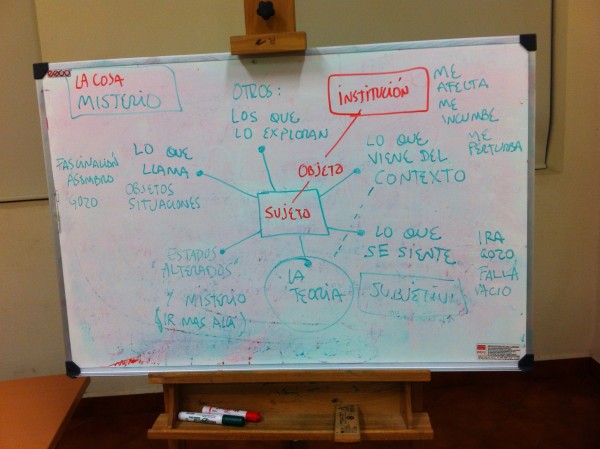
Me gusta este ejercicio de reflexionar acerca de mis actividades cotidianas. Pienso en las tareas del pasado, y también en las que hago por estos días.
Como tal vez puede sucederle a todos, a pesar del recuento de eventos, hay algo que siempre está a la deriva. Hay algo indeterminado que me impide comprender bien a bien de donde sale y a donde se dirige esta energía, o cómo pude alcanzar este momento de mi vida. Y aún cuando me produce angustia en ocasiones, por lo general estoy tranquilo y atento a todo esto, tomo notas, apuntes, esquemas, le doy cabida a todo lo que parece importante.
A diferencia del tiempo objetivo, que es el tiempo lineal-progresivo de los relojes que usamos para medir nuestras jornadas de trabajo, los flujos urbanos y muchísimas otras actividades sociales, el tiempo subjetivo es disperso, nos pertenece de una forma inherente, sincopado, pues se constituye desde la consciencia de la vida propia y de la propia muerte. Este tiempo es un estado mental al que entramos en ciertos momentos, y nos deja la sensación de que no hay un retorno ni hay una verdadera unidad en todo lo que hacemos. Es una temporalidad con su propia continuidad aunque se interrumpe constantemente. Sabemos que la vida es limitada y que la vida es vivir. Es tiempo simultáneo-paralelo al tiempo objetivo, pero existe sin relojes, es individual como el cuerpo, y se expresa desde el cuerpo: latidos del corazón, pensamientos y memoria, ritmos respiratorios, la cadencia al caminar, las entonaciones y las pausas al hablar, la adapatción a las estaciones del año y más. Es el tiempo de la vida de un ser, que es diferente al tiempo de los acontecimentos sociales y culturales acumulados que se sitúan en un horizonte histórico.
Vivimos fragmentados aún cuando tenemos la ilusión de que hay algo que da unidad a todos esos pedazos de experiencias que somos.
El tiempo subjetivo es vasto. Me gusta esta agradable sensación de que me pertenece. Tuve sensaciones parecidas cuando era joven, cuando era estudiante. Y hace dos años, cuando dejé de trabajar como maestro de tiempo completo en la universidad, recuperé su amplitud e intensidad, pero no fue de manera instantánea. Inició titubeante hace ocho años, cuando me inscribí en el doctorado, en Cholula Puebla, en el centro de México. Allá empecé a recordar lo valioso que era escaparse de las rutinas del trabajo y de las complicaciones de una ciudad como Monterrey, urbe industrial de 5 millones de habitantes, frenética e intolerante.
Ahora reparto mi tiempo según tengo humor o necesidad:
– las cosas de la casa donde vivo (alimentos, aseo, jardín, pagos, ejercicio, mascota, etc. )
– el internet (encontrar y archivar textos e imágenes de arte, de las diversas culturas, y del acontecer de mi país; comunicarme por correo o por facebook; dar forma a mis páginas, etc.)
– eventos, conferencias, reuniones
– trabajar en mis archivos de 25 años de producción (organizarlos, digitalizarlos, etc.)
– distracciones (ir al cine, beber cerveza, inscribirme en cursos de todo tipo, viajar, etc.)
Lo mejor de todo es evitar las rutinas, no sistematizar sino optar por una movilidad intuitiva. Bueno, en lo que se puede, no en todo es posible comportarse así.
La semana pasada fui al cine y pude ver dos películas que me conmovieron. Me gusta ir solo, y que los cines estén vacíos. Vi Birdman de Iñárritu, y The Grand Hotel Budapest de Wes Anderson. Ambas son hermosas obras, las recomiendo. Me cautivaron. Verlas el mismo día fue una buena experiencia. Especialmente Birdman, que explora el retruécano de la subjetividad como una voz interior.
Enmedio de mi tiempo subjetivo y mi dispersión, voy alimentando algunos anhelos para el futuro. Entre ellos por momentos sobresale un anhelo de escribir y publicar uno o dos libros, pero es algo que aún está opaco, que está hecho de bosquejos, apuntes. Otras veces pienso en retomar el dibujo, o trabajar en colectivos. Pero ese momento no ha llegado. Sigo en hiatus, en el reconocimiento de mi subjetividad. Soy un uróboro.
• • • • •
I like this exercise to think about my daily activities. I think of the things i did in the past, and also the ones I do these days.
Maybe, like it can happen to everyone, and despite counting the events, something is always missing. There is something unknown that keeps me away of understanding where do this energy come from, or where is it going, or how I could reach this point in my life. And even though sometimes I feel anxiety, usually I’m ok about it and ready to take notes, draw sketches or diagrams; I give room to everything that seems important.
Unlike the objetive time, which is the progressive-linear time we use in clocks to measure our workdays, the urban flows and many other social activities, the subjective time is scattered, it belongs to an inherent, syncopated form, as it belongs to the consciousness of one’s life and death itself. This time is a state of mind in which we enter at certain moments, and then we leave that place feeling that there is no return and no real unity in everything we do. It’s a temporality with its own continuity but also constantly interrupted. We know that life is limited and that life is mean to be lived. It is parallel and simultaneous to the objetive time, but there are no clocks. It is individual as the body can be, and it is expressed throughout the body itself: heartbeats, thoughts and memories, breathing rhythms, walking cadence, intonation and pauses to talk, adaptation to the seasons of the year, and more. It’s the particular life of one being, which is different from the time of the accumulated social and cultural events that usually are in a historical horizon.
We live fragmented even when we have the illusion that there is something that gives us unity to all those pieces of experiences we are.
Subjective time is vast. I like the feeling that it belongs to me. I had similar feelings when I was young, when I was a student. And two years ago when I stopped working as a full-time teacher, I regained its breadth and intensity, but not instantly. It began hesitantly eight years ago, when I enrolled in the PhD in Cholula Puebla, in central Mexico. There I began to remember how valuable it was to escape from work routines and complications like the ones I lived in a city like Monterrey, an industrial city of 5 million people, quite frantic and intolerant.
Now I use my time as I feel or need:
– Things in the house (food, cleaning, garden, payments, exercise, pet, etc.)
– The Internet (to find and archive texts and images of art, of different cultures, and of the political events of my country; to communicate by mail or facebook, uploading my pages, etc.)
– Go to events, conferences, meetings
– Work on my files, 25 years of production (organizing, scanning, etc.)
– Entertaining (movies, beer drinking, enrolling in courses of all kind, traveling, etc.)
Best of all is to avoid routines, to choose not to systematize but to allow a intuitive mobility. Well, when that possible is, because it is not always possible.
Last week I went to the movies and saw two films that moved me. I like to go to the movies alone, and when the cinemas are almost empty. I enjoyed Birdman, from Iñárritu, and The Grand Hotel Budapest, from Wes Anderson. Both are beautiful works. I simply recommend them. I saw them on the same day and that was a good experience. Especially Birdman, which explores the pun of subjectivity as an inner voice.
In between of my subjective time and my dispersion, I feed some yearnings for the future. Sometimes among them stands my wish to write and publish a book or two, but it’s something that is still opaque, made only of sketches and notes. And sometimes I think of going back to drawing, or doing collective art. But that time has not arrived. I’m still on hiatus, in recognition of my subjectivity. I am an Uroboro.
Hi Kelly! Yes, as I feel it, all throughout the 20 century has been a struggle between the modern rational social criteria (order, linear time planning - as Matt says -, scientism, high tech development, productivity, and more), and the criticism to these ideas and their government forms. We "must" relearn simple things, like what you say, that the subjectivity and the intuition are natural and important to the human life. For the modernity it does not mean that is forbidden to use our intuition everyday, but it means that we don't trust it as we trust rational thoughts. That's its discreet charm. But in the extensive, contradictory and complex art world we already know that, don't you think? Let's kill some time today, yeah !! Un abrazo !!
Kelly wrote on Mar 13:
Your post reminded me of a workshop I did a few years ago in the Netherlands - NOW:BREATH to get into the intuitive side of making, rather than the intellectual side. Away from "productivity" and into "experience."
Matt wrote on Feb 8:
Objective time to me seems pretty linear. Subjective time on the other hand, can make us feel like we are running in circles; folding back on itself, tumbling or even jumping forward … a kind of ellipsis; always to be reconciled with a perpetual and relentless present. There is syncopation that happens between the two which I always find interesting and reminiscent of linear vs non linear thought or the potential inherent in the space between the two. Some kind of open-endedness which I think is a valuable characteristic or objective of art. These are ideas I’ve always been fond of. That and the idea of “killing time” or which type of time does our human condition belong to?
And So It Begins…
Yesterday, when Shinobu and Matt checked in with me to make sure that I was good to go for logging in and everything today, they signed off by telling me to enjoy my last day of making art for six months. Which is probably not how things go for most RFAOH residents as I understand it. I’m under the impression that most people either have something non-artish they want some space to work on, or else have found themselves organically on hiatus from making art, and wanting to explore that experience. Not me. I’m purposely (and a little frighteningly) pulling on the brakes and screeching a pretty dynamic (if not recognized or remunerated) arts practice to a grinding halt. It scares the crap out of me, but I’m doing it because, as I explain in my proposal and bio, I think the nature of my arts practice requires some deeper investigation. (Which I’m hoping will take it to another level, but may just end up ending it altogether or transforming it into something else.) So am I ready? No. I’ve been cramming out art in January like a drug addict about to go into rehab. I’m afraid of having attacks (panic? seizures?) of some sort. But here I am, writing the first post on the first day.
In February, I’m going to be asking and trying to answer questions like these:
Is coloring in a coloring book art?
Is making/mailing a valentine art?
Is judging a baked macaroni and cheese contest art?
Is getting my hair braided art?
Is riding a bus and talking to strangers art?
Is cultivating a dish of bacteria art?
Is documenting someone else’s art art?
Is making a children’s book with a friend art?
What about making a catalog?
What about reading a list of numbers that someone else wrote down?
What about writing a proposal for an art project?
What about shoveling snow?
What about serving people ramen?
But I think I’m going to start by exploring the origin story of my coming to be an artist.
When I was a small child, I had a disorder that I now know is called “pica.” That means I ate things (constantly) that are not edible and have no nutritional value. I ate a lot of stuff—string, dirt, wax, hair—but my favorite thing to eat was paper, and I ate tons of it. I was sort of a connoisseur of paper, strongly preferring some types of paper over others. When I found paper I really liked, I ate it until it was gone.
My father was a musician and writer (and not terribly successful at either) who had spent a period of his life before I came into being kicking around in the art milieu now known as Fluxus. As residue from that period—a time when he was on pretty friendly terms with the artist/musician Yoko Ono—he had a proof or first edition of her book Grapefruit. When I discovered this book on our shelves one day, I fell in love with it. It was thick and square and chunky. It was (or looked) hand typed and the paper was soooo thin and delicate—like tracing paper. The pages smelled a little bit musty just from being among the other books, but the glue on the binding smelled alive and fresh. It had no cover so the pages were just a little softened and torn around the edges. I peeled at them, tasted a few, and then devoured almost the entire book. When my father discovered this, he was very angry at first but then started laughing. He told me a little bit about what the book was, and though I didn’t understand much of what he was explaining, I left the exchange feeling proud. Somehow, I had instinctively arrived at the best response to the book that could be arrived at.
I think of this as the genesis of my being as an artist—either because I (literally) ingested some wisdom about art making, or because I was drawn to approach a book in different way than it was intended to be approached. But the entire episode was also simply a compulsive act. The book could have had any kind of content—I would have eaten it regardless. If it even happened! This lives in me as a memory, but I am uncertain where it came from and have no one to verify it with.
So that’s where it begins. Is eating a book art? And also, did I eat a book?
Until next time, here is a photo of some bacteria I’ve been cultivating since mid-January (when it may have been art. It has changed since then and is now not art.)
It makes me wonder what prevents the "art-buzz" from happening when we try too hard for "art activities".. In any case, we, as co-directors, would like to encourage you all to get a "hiatus buzz" out of participating in RFAOH -- We and your fans look forward to your reports! (even on a non-activity (;)
Heather wrote on Feb 16:
Hi Ryan & Enrique (& Shinobu.) Thanks for reading and commenting. Yes, Ryan, you are totally right about not knowing what is or isn't art for certain -- I should be clearer: I'm not trying to determine what things are art from any objective place, but more something about what making art feels like for me. I want to get a better grasp on the feelings involved in the experiences that I think of as art making and not artmaking. And Enrique, I agree with you! I wonder if I may put all of the pieces of this puzzle together and find in the end that the activities that I get an art-buzz out of participating in are actually not artistic activities at all! We'll see!
Ryan wrote on Feb 13:
Instead of trying to define what is or is not art - this we really cannot know for certain - perhaps it would be more productive to, for instance, investigate why do you do what you do. What drives you? Where do your ideas come from? What are your intentions? What comes of your actions? What do you achieve by doing what you do? How and why do people perceive and or engage with your work? ...
enrique wrote on Feb 11:
Great ! It makes wonder about my own condition. I agree, and besides, what is there to separate? all roads lead to Rome ... and Rome is not only about the "art world". It might be a personal thing (like an enlightenment, a sense of life) or it might be a matter of the unconscious and the care of oneself. For me, art happens after the experiences of being, and not always happens. The being allows a builder to build the best walls, but these are not necessarily intended to be art. For better or for worse.
shinobu wrote on Feb 1:
Or did you eat art? Welcome aboard Heather!
1981
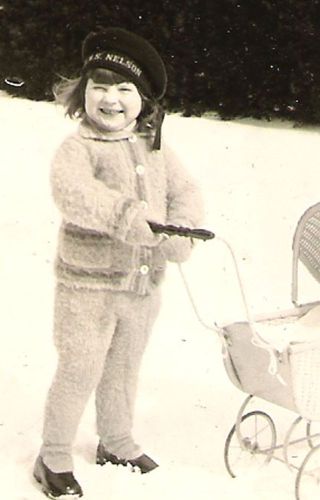
“I can’t say why some memories float and others sink.”




Kelly wrote on Apr 14:
Enrique - sorry for the delay in response. I will definitely check that book out! I really appreciate the information. I often feel like there is a lot of paper to be pushed...
enrique wrote on Mar 14:
Hi Kelly ! I used to work in an arts faculty at my university, and had some similar problems (I suppose): i.e. the standards that work for most of the university knowledges areas does not work as well in the art academic ambient, but we had to follow many of those standards, so we always had a lot of desk work in order to find a solution, and now that I see it from the distance, I think that there is no easy solution, or maybe none. The historic point of view of some books from Arthur Efland helped me a lot to see (and guess) what will the future may hold for those who, like us, enjoy the work of teaching in a university. It helped me despite the differences of two unequal art histories like the North American and the Latin American cultures, but also connected (more and more every day). Right now, I'm more interested in the recognition of some "autonomous" art activities that emerge without formal education. I guess art activities will always be available out of the art institutions. Best wishes for you !!
shinobu wrote on Feb 28:
Ahh, it's so great to have you all here.. The variety of on-hiatus projects, the motivations behind, circumstances -- all pointing to the prickly questions over "art as a profession". Let's keep it coming (;